
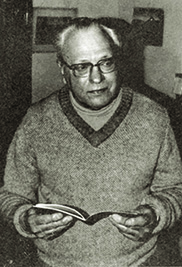
Basil Lazer discovered the writings of Emanuel Swedenborg after many years of searching for answers about life. The insights Swedenborg shared affected him deeply, to the extent that he wanted to make them more easily accessible to everyone. This became his passion and he dedicated himself to it.
Basil Lazer began offering selected quotes from Emanuel Swedenborg’s spiritual writings when he believed with a real earnestness that these quotes would be helpful to people and add meaning to their lives. His hope was that many people would be as captivated as he had been in first coming across them.
To fulfil that goal, Basil began to select quotes and arrange them in booklet form, letting the quotes speak for themselves, but at times offering his own commentary and excitement. He funded the production of these booklets himself, and covered the cost of sending them to people in Australia and overseas, sometimes in considerable numbers, particularly to Africa, where they were taken up with great joy.
When Basil left this life, his will included an amount of money so that his booklets could continue to be produced. A directive in the will led to setting up The Basil Lazer Trust to carry out this work. These current editions show Basil’s vision brought into a contemporary context with modern clear language.
Basil was born into an ultra-orthodox Jewish family in East Melbourne, Victoria, Australia in 1909. His mother had been widowed during her pregnancy with him and the family lived in poverty. Basil was the youngest of five children. His childhood and school life were miserable, unhappy years. He was teased at school and was constantly fearful. Because he was a Jew he was taught to hate Jesus and that the New Testament was lies which he was forbidden to read under threat of damnation. In adulthood he was led to Christianity and embraced it. Within the teachings of Christianity, Basil discovered that God is loving and not angry.
One day while on holiday, Basil was introduced to someone who like him was seeking answers. This person told him that he had received a book describing the afterlife in both heaven and hell. Basil was astounded that this could be possible, and wrote for a copy of the book, which was Emanuel Swedenborg’s Heaven and Hell. As he read it, he says that it gripped him with its teaching that what a person loves and desires most of all manifests after death and leads him or her to seek a life and community in accord with that.
Basil then read all of Swedenborg’s writings, which gave him a cohesive understanding of God, eternal life, regeneration, usefulness, good and evil, and the deeper meaning of the Bible. This gave birth to his determination to bring these great spiritual treasures to people, some of whom, he felt, would be overjoyed at finding such answers to their own existence. He never let up from this commission, which he felt God had placed with him. He found personal joy in serving a purpose in life for God’s greater purposes, and he did it well, and provided for its continuing future.
Those who knew Basil described him as an amiable, kindly gentleman who, although he remained single, was ‘Uncle Basil’ to the children of the families who became his friends. He left this life in 1991 at the age of eighty two, in Canberra, the capital of Australia, his home and place of employment in his younger years.
Basil wrote an autobiography of his spiritual journey, called Now It Can Be Told.
… Our relationship with God is based on kindness because God loves all people. However, God cannot do good things for us directly. Instead, God does good things for us through other people …